This year’s abundant amount of snow has stimulated a mass boom in ski mountaineering and freeride skiing in many mountains in Slovakia. So let’s take a closer look at where and under what conditions ski mountaineering is allowed in the Veľká Fatra Mountains and how to implement it so that it does not harm the surrounding biota.


The conditions of free movement in the Veľká Fatra National Park are regulated by the Visitor Rules, which were promulgated by the Decree of the Regional Office of the Environment in Žilina No. 8/2005 of 22 June 2005. In general, there is a ban on free movement in the 3rd and higher level of protected areas of the Slovak Republic, but in the Veľká Fatra National Park , a decree has set aside an area where ski mountaineering and free movement are allowed in winter.
It is an area of a non-forest zone in the area of Turecká – Malá Krížna – Kráľova studňa (spring) – the end of the Gaderská valley – Suchá dolina (Dlhý Grúň) – Repište – Krížna – Líška – Turecká (except for the part of Štrochy), it is possible to carry out ski mountaineering here in the period from November 1 to March 31. Access to the area is possible along hiking trails, downhill trails Turecká – Líška and from Suchá dolina along the ridge of Dlhý Grúň. The use of the area is possible during low and moderate avalanche danger (1st and 2nd degree according to the international scale).


Ski mountaineering area marked on the map.

The full text of the Visitor Rules of the Veľká Fatra National Park can be found here: Visitor Rules of the National Park

The task of Slovak National Parks and Reserves is to preserve nature in its most diverse forms for future generations and to make it accessible for leisure activities. However, these must be controlled and limited in order to fulfil the primary task – ” preserving nature in its most diverse forms for future generations.”
We often encounter questions from the public as to why there are various restrictions and prohibitions in the territory and why ski mountaineering or cycling is not allowed in the entire ridge zone of the Veľká Fatra National Park .
It is enough to realize that the winter season is a period of calm and many animal species spend this period in hibernation. However, there are also those that have evolutionarily adapted to survive in the most extreme conditions, and these are forest crested birds.
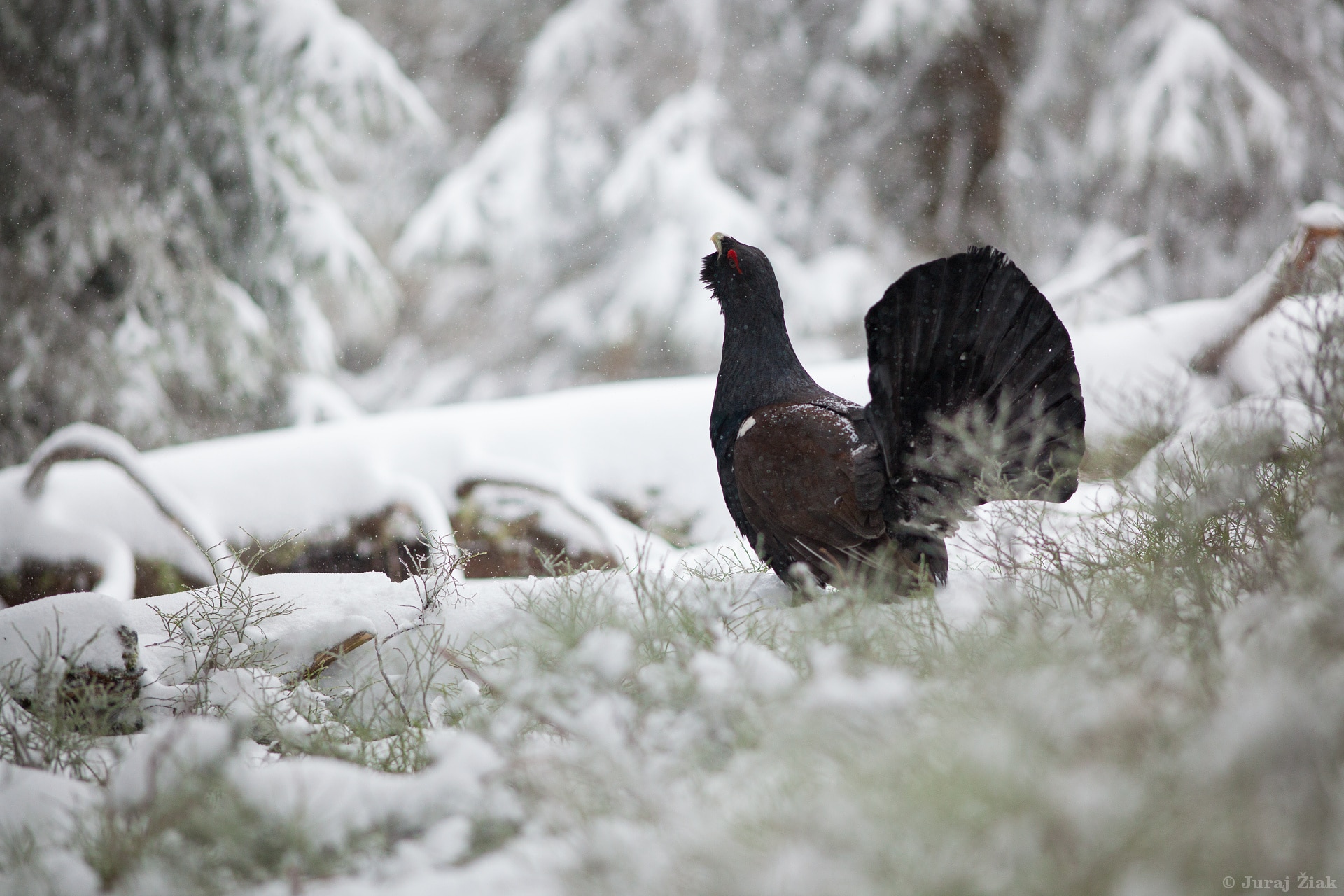
The black grouse (Tetrao tetrix ) as well as the capercaillie (Tetrao urogallus) or the mountain partridge (Tetrastes bonasia ) remain faithful to their habitat even during the most extreme winter, which is located at the upper border of the forest or, in the case of the “mountain grouse” , even above this border. The number of these species is rapidly declining, and the mass expansion of uncontrollable tourism and ski mountaineering can also be described as a secondary factor. This is one of the most important arguments why some locations are not allowed to be used for recreational winter ski mountaineering and free movement.
Birds are species with extremely high demands on resting zones. In winter, they remain at altitudes of 1000 – 1500 m n. And this is the zone used by ski mountaineers.
Therefore, let us bear in mind that we are in an area inhabited by these species since the Ice Age (glacial relics). These species feed exclusively on tree needles in winter, especially spruce, and in order to maintain body temperature and energy, they do not make large flights in winter. Of course, as long as they are not disturbed by uncontrolled ski mountaineering in zones where movement is not allowed.

Male capercaillie (Tetrao urogallus).

Male black grouse ( Tetrao tetrix ).
To better illustrate the issue, we will mention the strategy of the black grouse (Tetrao tetrix ) when waiting out extreme frosts. “Hôlniaky” dig some kind of snow tunnels to rest in severe frosts and wait out under the snow, where the temperature is often more acceptable and close to zero values. In this way, birds can wait under the snow for hours until they are “pulled” by the need for hunger and set out to replenish energy losses. Outside, another danger lurks for them – predators. As long as they are not disturbed, they can significantly save energy losses in extreme cold with this strategy. If they are constantly disturbed by ski mountaineering at the sites, it can have fatal consequences! Therefore, let’s give these extremely interesting and beautiful species a little peace so that they can survive the next winters and be enjoyed by generations that will come after us and our children.

Year-round used mountain range for grouse (Tetrao tetrix ) The photo captures the flow of taps.


The capercaillie (Tetrao urogallus), unlike the capercaillie (Tetrao tetrix), uses only the edge of the forest zone, winters in the top old forests, unfortunately even here it is often disturbed by freeriders.


The smallest representative of tetraonids – the partridge ( Tetrastes bonasia).

The mountain zone is used all year round by the grouse (Tetrao tetrix). Its presence is often revealed only by droppings or footprints in the snow.


Text: Ing. Juraj Žiak
Photo: Juraj Žiak, Radovan Reťkovský, Šimon Kertys