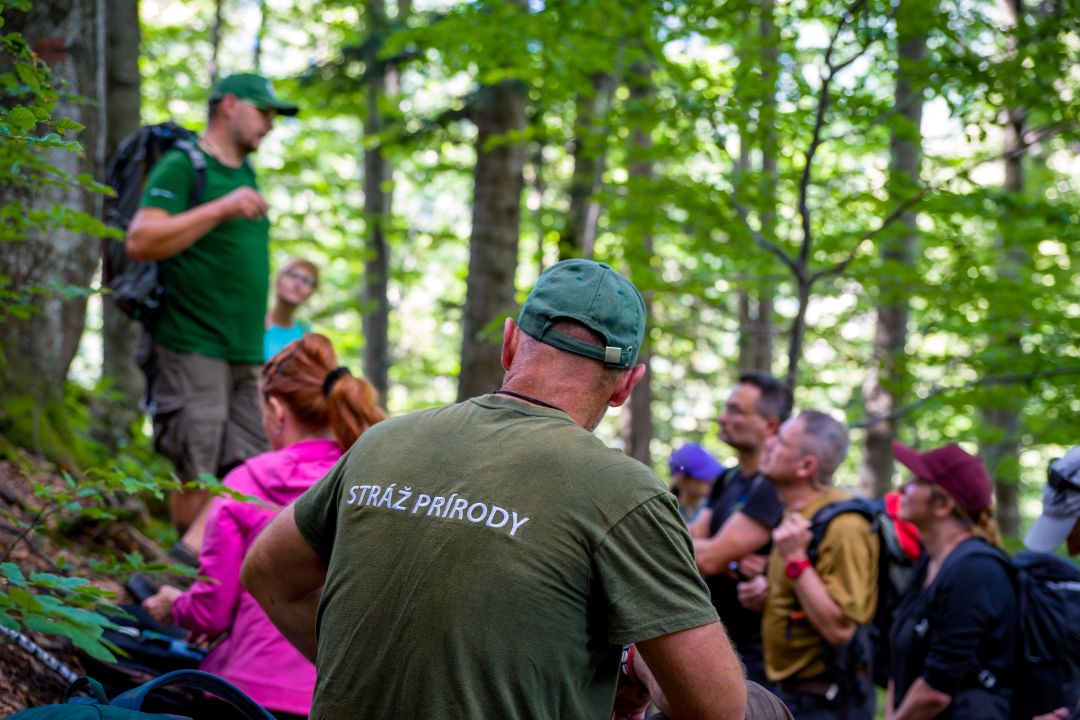
Ideal hiking weather, friendly guides, beautiful views and plenty of interesting information awaited participants at the latest Day with an Expert, which the Administration of Veľká Fatra National Park organizes free of charge for the public.
The programme of Day with an Expert on Saturday, 25 July changed first thing in the morning. Nature rangers Pavel Plavec and Ivan Mikuš chose a less demanding route for the hike than originally planned. Instead of following the green trail from Belianska Valley through Dolný Borišov Valley and Košariská to the Chalet under Borišov, the group was taken by bus deep into Necpalská Valley, about two kilometres from Balcierovo, saving time and energy for everyone. “If we went the original route, we’d finish the ascent at the Chalet under Borišov. This way we’ll have enough time and strength to climb Borišov itself,” the organisers explained the last-minute change.
After basic information about how the Veľká Fatra mountain range was formed and some organisational instructions, Ivan Mikuš concluded the opening remarks: “We’re here to be in nature, to draw energy from it—whether from the trees, the flowers, the sun, the sounds of nature, or the stream. Up at the chalet there’s an amazing atmosphere, so let’s hope we have a lovely day.” We set off.
Butterbur isn’t burdock
Even before Balcierovo, the head of the Veľká Fatra nature rangers, Pavel Plavec, pointed out the butterbur plant, which many people mistakenly call burdock. “Burdock is a completely different plant. The root of butterbur was used here in traditional folk medicine, much like ginseng is used in China. Butterbur is a legally protected plant of European importance. We might say it grows everywhere here, in every valley anywhere in Slovakia, but in Western Europe it has already disappeared. That’s why it’s protected across Europe. Industrialisation and the ever-increasing human use of the landscape have dramatically reduced its numbers. That’s why it needs protecting. Even here, butterbur is being pushed out by invasive plants, for example Japanese knotweed. Right at the start of Necpalská Valley there’s a fairly large colony that crowds out all plant species in the area. Knotweed has the unfortunate advantage that it can sprout from tiny cuttings even after several years. So it can end up in a new place by being carried in, for example on the tyre of an off-road vehicle. In the national park, we’re gradually clearing all land of invasive species,” Pavel Plavec explained.
You don’t do nature ranger work for the money
During the walk, everyone has a chance to talk with the experts. We were interested in how someone becomes a nature ranger. As the head of the Veľká Fatra nature rangers explained, professional competence is proven by passing an exam before a commission at the district office. The exam covers basic knowledge of criminal law, misdemeanours, legislation on nature and landscape protection, as well as local geography and the geography of the area where the person will perform the role. According to Pavel Plavec, there are officially enough nature rangers, but in reality there are too few. In the past, many people took the exam not to protect nature, but for the benefits that came with it, such as free movement in the highest level of protection or unrestricted vehicle access into nature. However, this has been restricted by law: each ranger must have a signed agreement with the landowner allowing them to perform ranger duties there. A member of the nature ranger service identifies themselves with a badge, but is not required to state their first or last name. According to Plavec, tense situations in nature are rare. But rangers are rare too. “For the whole area of Veľká Fatra—784 square kilometres—there are six of us. Ideally, we’d have two for each valley.”
He himself got into this work after burning out in his previous job at a bank. “I took a sabbatical, during which I went to the forest administration and asked them for any job in the forest. I planted saplings and I grew to like being out in nature. When the national park was looking for a nature ranger, I applied,” Pavel Plavec described his story. Ivan Mikuš, on the other hand, had always dreamed of a job that would also be his hobby and calling. “I was drawn to mountain rescue or air rescue, because I was into paragliding. Even while studying at university in Banská Bystrica, where I studied environmental education and environmental management, I did my placement in Veľká Fatra. Then I moved away from this environment, had various other jobs for twenty years, but then I happened to meet a friend who told me the national park administration was looking for people. So I went there to drop off my CV and met colleagues who still remembered me from my student days. They wanted to take me on for environmental education, but I didn’t want to do that. I wanted to be out in the field—working, carrying supplies, simply helping the national park.” Both agreed, however, that you don’t do nature ranger work for the money. “You have to enjoy it,” Ivan Mikuš said.
Ivan Mikuš proved his words about carrying supplies just a few minutes later. As we walked past two men resting while hauling a backpack weighing over seventy kilos, he immediately offered to help and didn’t take it off his back until the finish at the Chalet under Borišov. “A proper porter never gives up a carry with a load once he’s packed it onto the frame and put it on his back. Even though you can’t compare the reinforced stone paths in the High Tatras with the well-worn forest trails here—it’s a completely different league. If you don’t try it, you don’t know; you simply have to experience it.”
A successful climb to the summit
During another break, at the point where the forest ends and views opened up towards Borišov and Ploská, Pavel Plavec explained the zones and levels of protection. Zone A is a non-intervention area, i.e. the strictest, 5th level of protection. Nature is left to develop on its own and any economic activity, including logging, is prohibited. In Zone B, limited interventions are allowed, primarily to protect habitats, and the 4th level of protection applies. Zone C is intended for sustainable use. In this zone, gentle forest management is possible and it also serves tourism development. Zone D is a transitional zone where settlements, infrastructure and tourist facilities may be located. These are typically buffer zones around villages or infrastructure on the edge of the park. The lowest, first level of protection includes all other land in Slovakia.
“The Borišov National Nature Reserve covers an area of 449.74 hectares. It was declared in 1981 because rare beech–fir stands with dwarf pine have been preserved here. I’m sure you all know that the alpine meadow part was created artificially. It was completely deforested during Wallachian colonisation, when the Wallachians began grazing livestock here, and that’s why the open area remained without regrowth,” Pavel Plavec continued. “From Zone C, or the 3rd level of protection, you must not pick forest fruits more than two metres from the trail. That’s because several animal species live in the protected area and feed on those fruits.”
After a short rest at Chata pod Borišovom, the participants of the Day with an Expert, in ideal hiking weather, successfully climbed to the Borišov peak at an altitude of 1,500 metres above sea level.
Not checking people, but monitoring wildlife
The last stop of the trip, on the way back, was Balcierovo again, where the nature rangers once more spoke about the essence of their work. “There’s no need to be afraid of nature rangers. Our main job isn’t checking people, but monitoring various species of animals and plants. And any breach of the visitor rules that we find, we most often deal with by a warning. We only pull out a ticket book in cases of knowing and deliberate rule-breaking,” Ivan Mikuš said.
“We also spend a lot of time repairing hiking trails. When we finish repairing one, we start repairing another. And we have to carry all the necessary tools and materials for the repairs up ourselves, on our own backs. But the most time really goes into monitoring. For example, here we monitored a rare woodpecker—the three-toed woodpecker—for several years in a row. It’s a relict species that lived here back in the Ice Age. Then there are, for instance, large colonies of nuthatches. The Eurasian nuthatch is the only bird in Slovakia that can climb down a tree headfirst,” Pavel Plavec rattled off interesting facts.
Tourists and nature together
The quiz question—what year the Borišov National Nature Reserve was declared—was answered correctly by an attentive participant, who won a small gift from the Administration of Veľká Fatra National Park. The next Day with an Expert will take place on 22 August at Smrekovica.
Days with an Expert are supported by the Swiss–Slovak Cooperation Programme, the Tourists and Nature Together Project, through the support measure “Support for sustainable tourism and strengthening biodiversity in protected areas”. Project supported by the Swiss contribution to reduce economic and social disparities in the EU.