Photo: Tomáš Hulej
The State Nature Conservancy of the Slovak Republic, in cooperation with the Fatra Brown Bear Intervention Team and the University of Veterinary Medicine and Pharmacy in Košice, is testing a new method of deterring bears. The goal is to build a negative association with humans and inhabited areas in the bears.
Aversive therapy is a non-lethal method that associates the presence of humans or being near human dwellings with an unpleasant experience for the bears. This way, the bear should develop a negative association and start avoiding inhabited areas. The method is therefore used for bears that have lost their shyness and visit the built-up areas of municipalities in search of food. “This method is commonly used, for example, in the USA and Canada. It involves the use of rubber bullets, alarm shells, canine interventions, or electric fences. Its goal is to restore the predator’s natural shyness,” said Juraj Žiak, head of the Fatra intervention team.
The bear had an undesirable habit
Members of the Fatra intervention team applied the method in April to an adult individual that they monitored for two and a half months. “The problem bear repeatedly entered the built-up area of the village of Kraľovany – Rieka part and the village of Šútovo. Despite the use of several preventive measures, it was not possible to change this individual’s undesirable habit. For this reason, we proceeded with a targeted capture to set up telemetric tracking and apply aversive therapy,” said Juraj Žiak.
The bear was lured into a capture device, where it remained for nine hours before chemical immobilization to gain a negative experience from the location. After sedating the bear, members of the intervention team obtained biological material samples and performed all biometric measurements. The approximately ten to twelve-year-old adult male in excellent condition weighed 243 kg with a front paw width of 15 cm. After a veterinary examination, a telemetry collar was fitted to the individual to determine its exact position in the coming months. Finally, the bear was marked on both ears with tags for later precise identification after the GPS collar is disconnected.
“This monitoring method is primarily used for adult individuals whose necks will not thicken even during hyperphagia and body fat gain. In specific cases, it is possible to use this method for immature individuals in a short-term time horizon,” said veterinarian Ladislav Molnár.
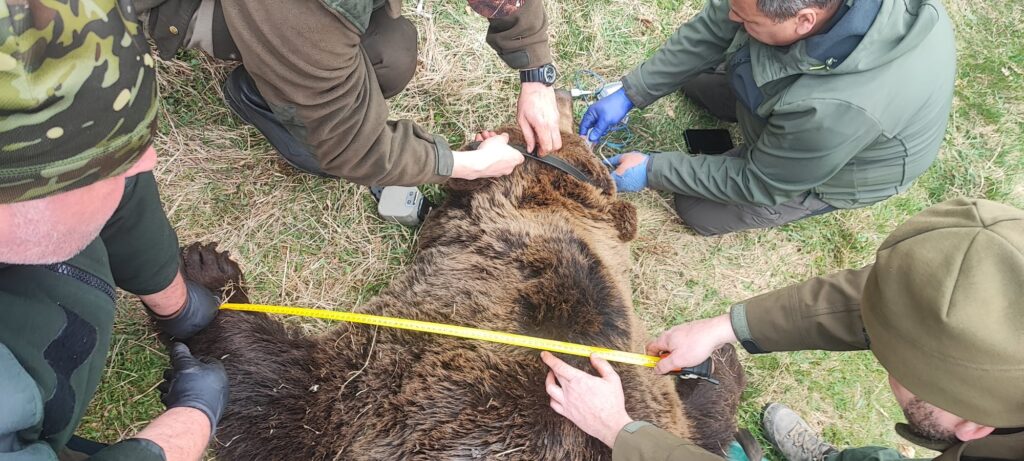
Photo: Brown Bear Intervention Team Fatra
Therapy for a quarter-ton predator
Before the aversive therapy itself, the bear was allowed to wake up from the anesthesia. “The individual must wake up from the anesthesia to full consciousness in the capture device to instill a negative experience. If the individual were moved to another location or woke up outside the capture device, this effect would not occur because chemical immobilization causes so-called retrograde amnesia, which is known to erase short-term memory in individuals. The bear would thus not remember any negative experience associated with the capture and the place,” said MVDr. Molnár.
Subsequently, members of the Intervention Team applied the aversive therapy itself in the form of sound and light stimuli, spraying the individual with bear spray containing capsaicin, and firing rubber projectiles, which accompanied it after release from the capture device. “The individual reacted well and left the critical location of the built-up area. According to information from the GPS collar, in cooperation with the staff of the State Nature Conservancy, we retrospectively recorded that the individual spent the following days in a windthrow area in the Šútovská valley, far from human settlements,” stated Žiak. According to his further words, three weeks after the capture, the bear attempted to cross the Trusalová – Podhradie terrestrial biocorridor into the Veľká Fatra National Park, but probably due to traffic on the I/18 road, its attempt was unsuccessful. Subsequently, it moved to the ridge of Malá Fatra, where it stays to this day. The movement of this individual will continue to be closely monitored to determine if the aversive therapy had a corrective effect. “Despite the fact that this bear was synanthropic, it got a second chance,” concluded the head of the Fatra Intervention Team.
Video: Brown Bear Intervention Team Fatra
A young bear also tried the trap
During the preparation for the capture of the problematic individual, an immature bear also experienced aversive therapy firsthand, unexpectedly getting caught in the set capture device two days before the problem individual. The young bear was not the target individual for capture, but camera trap records showed its regular occurrence in the monitored location near human dwellings. Out of curiosity, it accidentally entered the capture device and triggered the pressure mechanism. “We immediately consulted the unplanned capture with the cooperating veterinarian, who suggested an aversive therapy procedure: marking the individual with colored spray without chemical immobilization and subsequent release the following morning.” As Ladislav Molnár assured, the capture device is designed so that a bear can spend more than twenty-four hours in it without harm to its health. Before release, the individual was irritated with bear spray containing capsaicin and was subsequently released from the capture device while fully conscious, being deterred with non-lethal rubber bullets as it fled into the forest. A GPS collar was not fitted to the immature, approximately sixty-kilogram individual because it will still grow and the collar would soon start to choke it. The latest collars available to the intervention team already have a built-in camera that sends a short video every two hours in addition to coordinates. “Our goal is to obtain as much data as possible about problematic individuals so that we have their movement well-mapped, so that we have the effects of aversive therapy documented, and so that we are sure that physical elimination is only the last option after exhausting all previous measures,” said Juraj Žiak.
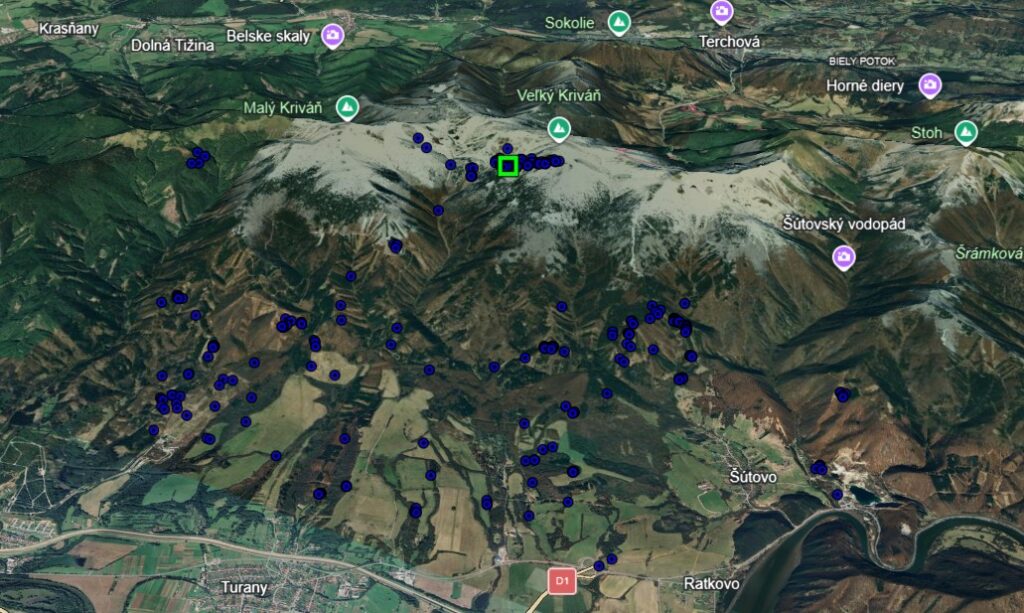
Map of bear movement as captured by its GPS collar. Photo: Eng. Slavomír Finďo
According to current data from the GPS collar, the monitored individual moved from the sub-mountain part to the alpine meadow part of the Malá Fatra National Park at the beginning of June. “We assume this is caused by the end of the bear mating season and also the energy-rich grazing on alpine meadows above the upper forest limit. The monitored individual probably has this migration habit established annually for a long time,” concluded Žiak.