On 15.2.2025, in cooperation with the Secondary Vocational School under Bánoš in BB and the Slovak Association of Beekeepers, we organized a professional seminar “Asian hornet – a threat to our region?”.
The Asian hornet (Vespa velutina nigrithorax) entered Europe, the French port city inadvertently with goods from China in 2004. Since then, it has colonized many European countries and is advancing further across Europe. In 2024, it was also recorded for the first time in Slovakia, in Palárikovo, where its nest was also found and disposed of in the fall of 2024. The Asian hornet advances 80-100 km annually by its own efforts. However, it also proceeds over longer distances by transporting it along with the goods.
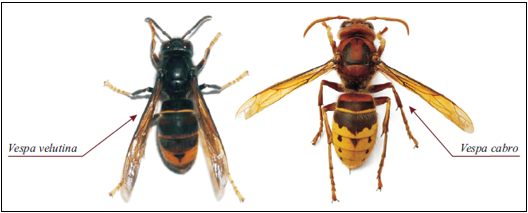
The Asian hornet is smaller than our European common hornet. Adults measure around 22 mm. It is almost all black and, unlike our hornet, has the ends of its legs yellow. Overall, it has less yellow color on the back of the body as well.
In our country, it has practically no predators and, with the queen’s ability to lay up to 15,000 eggs per year, it has a great reproductive potential, which allows it to spread quickly. Only queens survive the winter, which in the spring establish the first nest with workers in a dry, protected and safe place (attics of buildings, garden houses, in the facades of buildings, under roofs, in trees, sometimes in hollows in the ground, any other dry place). After hatching, they either enlarge the original nest or fly away and establish a second, new large nest. This is often high in the treetops near watercourses or other water sources. In addition to workers, this nest also breeds queens and males at the end of summer, often 80 cm in diameter. After hatching, the queens fly out into a wide area, where they establish their own nests after wintering.
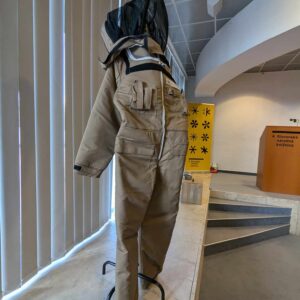
Adult hornets feed on sweet juices such as nectar or sugar from fruits. The larvae feed on animal food – insects. They often use bees as a source of food, which hunt near the hives. They also love to visit flowering ivy. Outside the nest, they are not dangerous to humans, they do not attack without a cause. However, they are extremely aggressive around the nest and when trying to eliminate it, more so than our hornets. They have a longer sting and can eject venom over a longer distance. Without a special protective suit and gloves, without protection of the face and head, it is not recommended to handle the nest. The hornets of the intruder are chased by tens or hundreds of meters and a large part of the colony attacks at once. Therefore, the disposal of nests belongs in the hands of specialists with the necessary equipment.
The Asian hornet is a threat to domestic insect species (reduction and destruction of biodiversity), to beekeepers (destruction of bee colonies, negative impact on their health and survival, negative impact on honey laying – bees do not produce honey under stress), to fruit production (by eating fruit or its parts, they degrade or destroy crops and yields). Last but not least, they are a threat to humans, as their nests are often built near urban areas or directly in them and there is a risk of being bitten in their surroundings.
It is a matter of time before the Asian hornet appears here in Turiec or in the surrounding area. Therefore, your cooperation in monitoring its occurrence is also necessary. You can download the “Stop the Hornets” app (from SPP), through which you can report suspected hornets and where you can find a lot of other information. If you see an insect that could be an Asian hornet, send a photo or photos of it to srsen@sopsr.sk to verify if it is a hornet. Caution – do not kill the hornet, if you dare, you can try to catch it in a net or container. It is often confused with other insects, many of which are protected, rare or very useful. Further information can also be found on the website https://invaznedruhy.sopsr.sk/srsen-azijsky-vespa-velutina-nigrithorax/ or in the presentation from the conference of Mr. Bc. Ing. Richard Šníder from the Secondary Vocational School Pod Bánošom in Banská Bystrica – Black-chested hornet (VespaVelutinanigrithorax). The documentary is the copyright work of Mr. Šníder, for which he reserves the copyright. The information is as of the date of the conference, which may be out of date over time.

Text : zoologist S-NPVF
Photo : archive of S-NPVF, cover image is an internet source