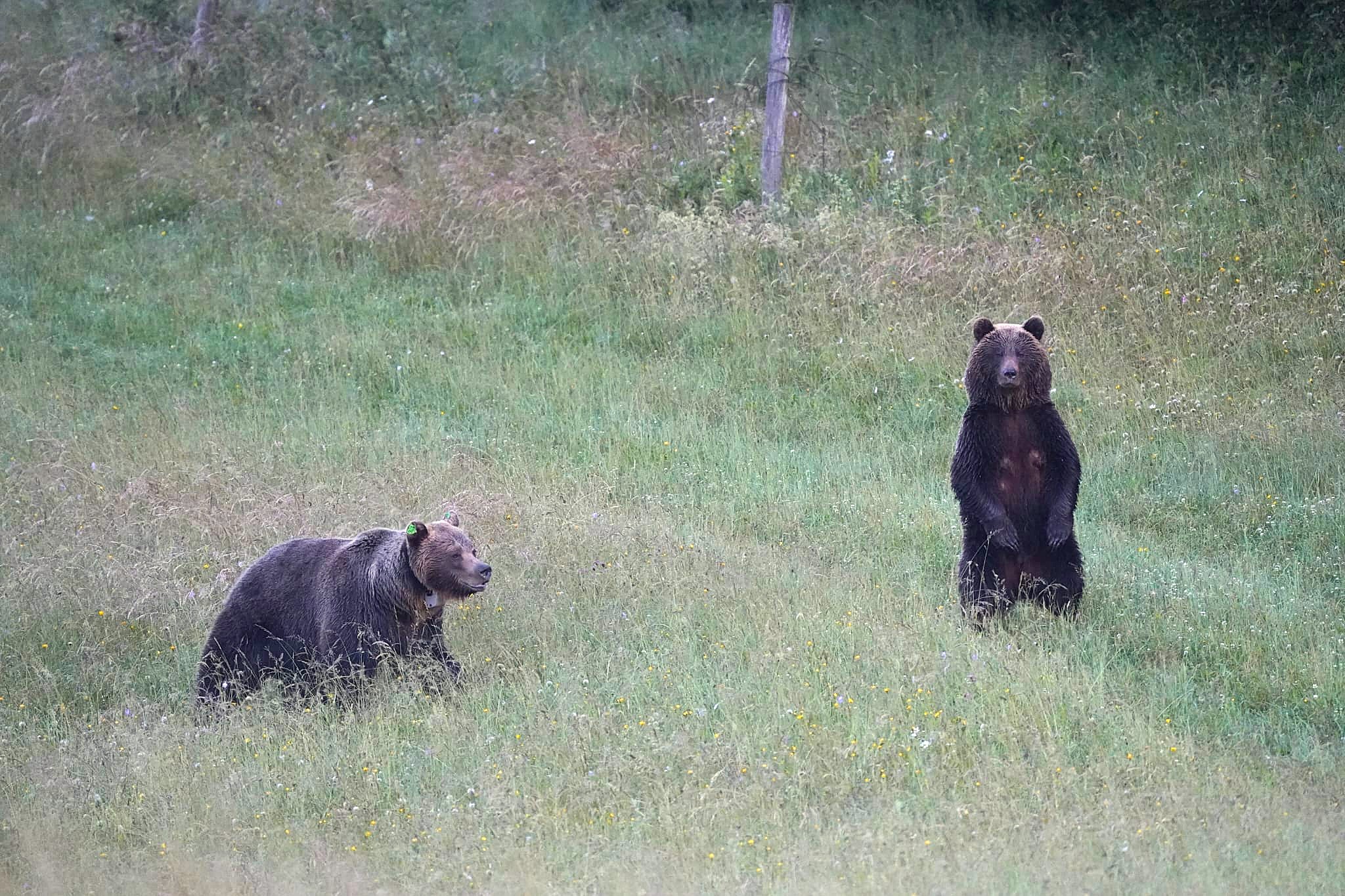
The change in climatic conditions goes hand in hand with new conditions for the life of several invasive species of animals or plants. In recent years, species that did not occur naturally in Slovakia or Europe have gradually spread much more intensively to our country. Many of them are no longer exotic in our country, they have become so domesticated here that we can already consider them common. In the area of competence of the National Slingshot Administration of the Veľká Fatra, these are mainly the following species: American mink and river nutria, musk muskrat, pureed bear, bear-like dog.

A common characteristic of invasive species is that they expand rapidly, have good reproductive capacity and, in many cases, have a better developed ability to exploit trophic resources than native species. In the case of the muskrat (Ondatra zibethicus) and the river nutria (Myocastor coypus), we can say that these species have taken advantage of and occupied an empty ecological niche between species such as the European beaver (Castor fiber) and the water gnawer (Arvicola amphibius) and do not compete with each other due to their different size. On the other hand, however, many of the mentioned species can negatively affect other native populations of species, often rare and protected animals. Therefore, they have no conservation status. An example of this is a very rapidly expanding species – the American mink.

The American mink poses a serious danger to the critically endangered European mink on a pan-European scale. And it also has an impact on the populations of the black polecat, the ermine weasel and the mouse-eating weasel. Even as a food opportunist, it influences many species of its prey: the water gnaw, several species of waterfowl, the river crayfish, the snorkel and collared snakes, and all species of amphibians. In the area of competence of the Administration of the Veľká Fatra National Park, there have been several records of its occurrence in the last 15 years. These are mainly knocked down individuals, but there are also cases of direct documentation. Several finds come from the area of Turiec around the urban areas of the villages: Socovce, Laskár, Karlová, Blatnica, Ivančiná. In the area of the Turiec Basin, one of the last Slovak mink farms is also known. Minks have exceptional, highly valued fur and were therefore bred in specialized farms, especially in the past. Different color mutations are bred there. Therefore, it is not excluded that the gradually expanding population in the area of the Turiec Basin could have arisen and is still subsidized by individuals from artificial breeding. Although photo documentation from this farm proves a preference for color mutations that are not found in nature.


The American mink belongs to the original North American species with considerable reproductive ability in our country as well as throughout Europe. It is a weasel-like beast characterized by a medium to elongated body, a flattened head with a pointed snout, a shorter mustache and a long tail. The feet have a short webbing that does not reach the end of the toes. The maximum weight of individuals reaches 2 kg. The normal coloration of the American mink is dark brown to reddish-brown, only on the lower lip and on the chin is white. Spots of various sizes appear on the throat, chest, abdomen and groin. Males are larger than females in adulthood and can be twice as heavy. (Wilson & Mittermeier 2009)
Mink is tied to various aquatic ecosystems (rivers, lakes, canals, dams, wetlands, etc.) Shallow, slow-flowing eutrophicated watercourses are ideal for it. He is one of the typical food opportunists. In its diet we can find invertebrates, as well as all groups of aquatic and terrestrial vertebrates.
As a strongly expansive species negatively affecting native species, it has no conservation status. Currently, in many European countries, measures are being implemented to regulate or completely eradicate them.

River nutria and muskrat muskrat. Both species occur in the area of the Turčianska basin, as well as in the Váh basin from the Krpeľany to Vrútky reservoir. As mentioned earlier in the article, it is clear that these species have taken advantage of and occupied an empty ecological niche between species such as the European beaver (Castor fiber) and the water gnaw (Arvicola amphibius) and do not compete with each other due to their different size. In the case of river nutria, however, the course of nesting of waterfowl is negatively affected, especially on stagnant waters. River nutria was confirmed by direct observation in the cadastre of the villages of Nolčovo, Turany and Blatnica. In Blatnica, however, it may be an individual escaped from domestic breeding. River nutria is an underwater species of South America. Due to its highly prized fur, it was also introduced to other continents and today lives in North America, Europe, Africa and Asia. In Slovakia, it is common mainly in the south of the territory. The climatic conditions in the north of Slovakia do not suit it very well, because it does not tolerate harsh winters, but it still survives in the Turiec area and reproduces. Interestingly, however, almost all individuals older than one year usually have thawed tails.

Another confirmed invasive species of small carnivore in the area of competence of the Administration of the Veľká Fatra National Park is the pure-bred bear ( Procyon lotor). This is the first documented data of this kind in the area administered by the Administration of the Veľká Fatra National Park. This information was captured on a camera trap by Lukáš Matej on 2.6.2020 near the village of Sučany.

However, it does not have to be a migrant, but it can be an individual escaped from domestic breeding. In 1985, there were local attempts to plant it in Slovakia (e.g. Zvolen) (Sládek & Mošanský, 1985). Nevertheless, its spread in our territory is not as fast as it is in the case of the bear-like dog or the American mink. In the years 1951 – 1990, it was reported in Slovakia in eight squares. Between 1991 and 2012, it was reported in 85 squares, i.e. 13.5% of the territory (Anděra & Gaisler, 2012). According to hunting statistics, in 2002 two individuals were shot near the village of Gemer, four near Tureň nad Bodvou and in 2008 an individual near Gerlach (Krištofík & Danko 2012). The last documented data on the occurrence of this species from the competence area of the Veľká Fatra National Park is from 28.3.2021 from the Hadviga locality in the cadastral area of Břestia district of T.Teplice, where Mrs. Gabriela Húsová managed to capture a teddy bear with a mobile phone. (Apfelová 2021)

The original distribution area of this species is on the North American continent. It got to European fur farms around 1927, first to Germany, and in 1930-1935 individuals were already observed in the wild. The current area of its occurrence covers a substantial part of Germany and spreads to the surrounding countries of Central Europe.
As an introduced invasive species, the teddy bear has no conservation status in terms of the Nature Conservation Act.
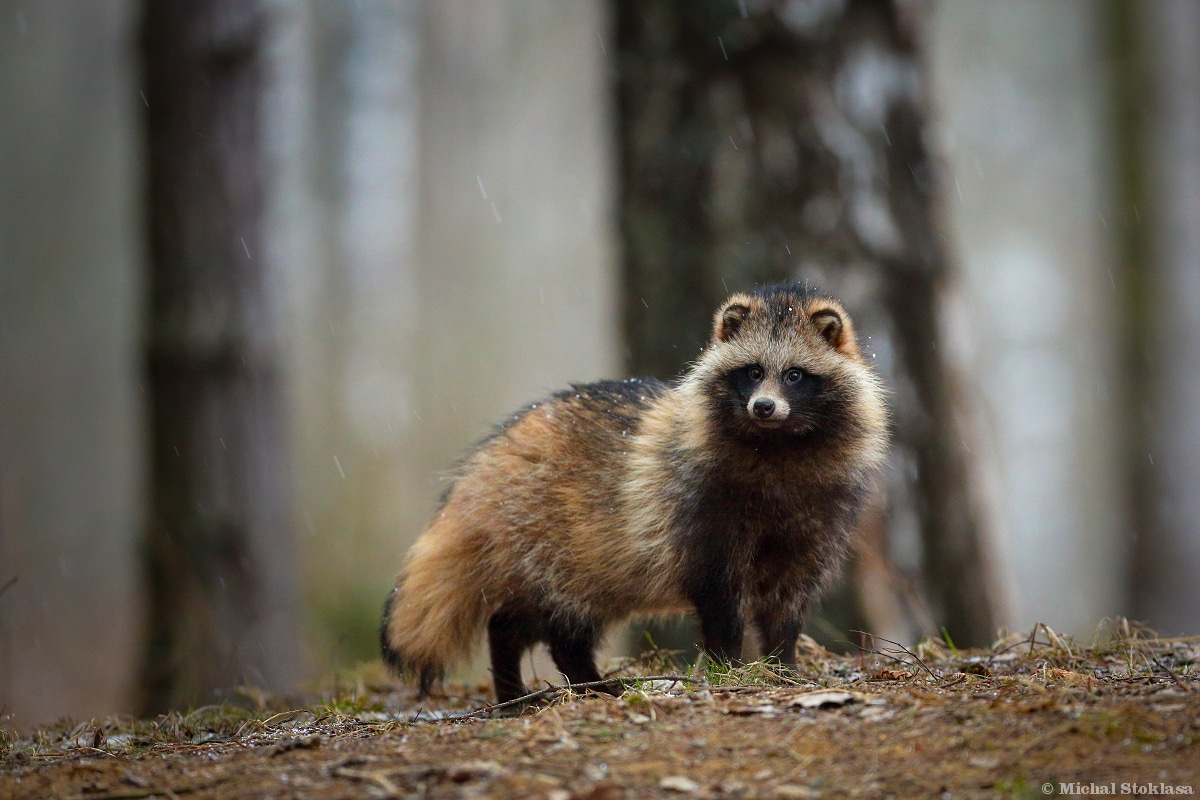
Another species, the spread and occurrence of which in the area of the Turiec Basin and the competence area of the Administration of the Veľká Fatra National Park has been documented several times, is the bear dog (Nyctereutes procyonoides).

Its color and size are more reminiscent of a badger than a pure-bred bear, with which it is often confused. As an introduced invasive species, it poses a possible danger to native fauna. The species originally comes from the Far East, including Japan and Southeast Asia. From introduced populations in Siberia and the European part of the former Soviet Union, it spread further west. At present, the bear-like dog can be considered a widely distributed species throughout Europe. In 2012, its occupancy was proven up to 90.1% of our territory. (Anděra & Gaisler 2012).

In the area of Turiec, a knocked down individual was documented near the village of Dubové (Apfelová 2015), another knocked down individual was near the village of Ratkovo (Žiak 2019) and a number of direct observations from the village of Necpaly are also recorded (Remeník 2019). Very interesting was also the data of the chicks from the area of the saddle of Malý Šturec at an altitude of 890 m above sea level. The species has predominantly twilight and nocturnal activity and, unlike the pure-bred bear, cannot climb trees. At present, the species is widespread in the entire Turčianska basin as well as in the surrounding valleys, all tributaries of the Truc and Váh rivers.

Author of the article: Ing. Juraj Žiak
Photo: Lukáš Matej, Martina Ondrejkovičová, Michal Stoklasa, Gabriela Húsová, Mária Apfelová, Juraj Žiak
Source: Mammals of Slovakia, distribution, bionomy and conservation, Ján KRIŠTOFÍK, Štefan DANKO (2012)