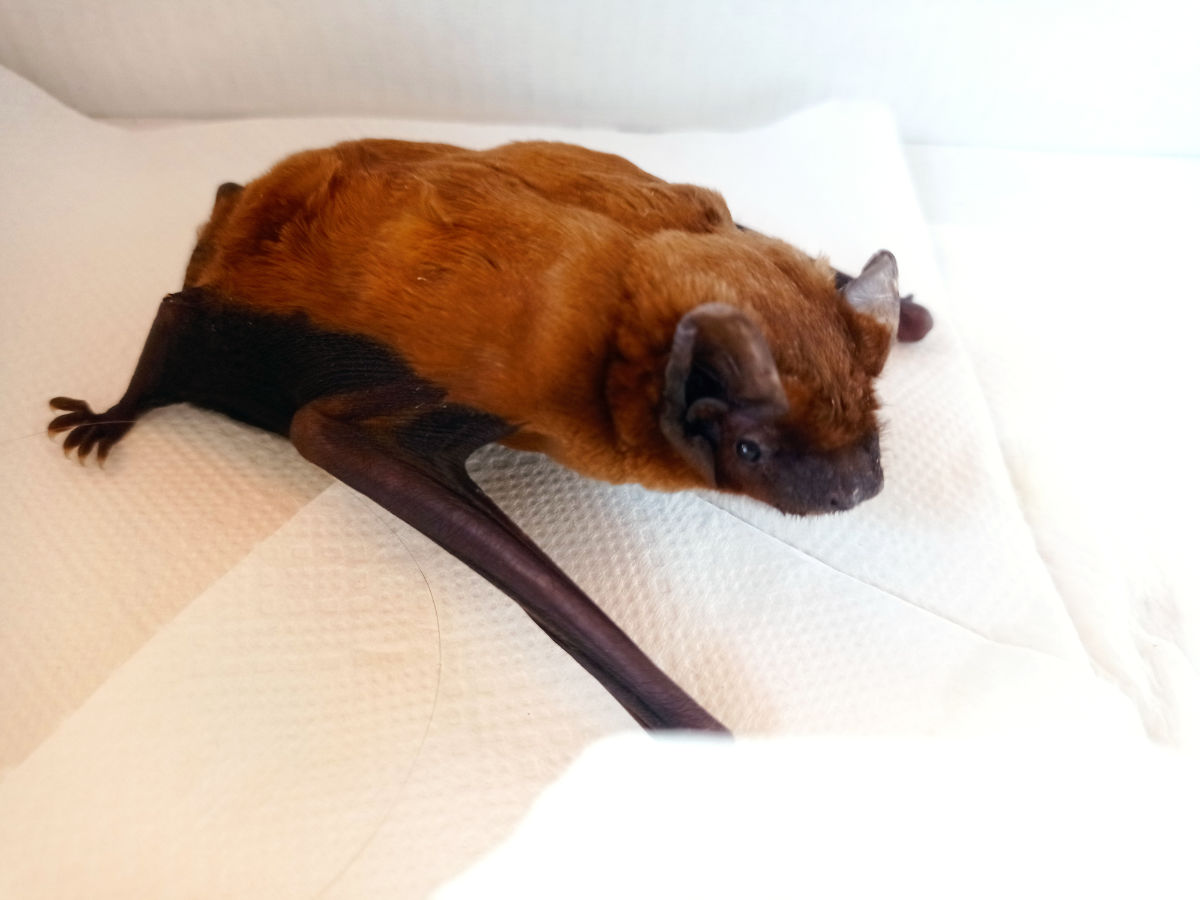
Bats are not among the most popular groups of animals for many people. We pass each other in time and space, and even though we live relatively close to each other, often closer than we realize. They escape our attention due to their size and nocturnal way of life. However, they are fascinating mammals and it is worth taking a look into their way of life and learning more about them.
Bats are the only active flying mammals on Earth. Their body is covered with fine fur, the wings are leathery, the flight membrane is between the elongated links of the fingers. Chicks suck milk after birth and are completely dependent on the care of their mother for the first 3 weeks of life.
They have a unique way of orienting themselves in space, namely echolocation. They make sounds beyond the limits of our hearing and by listening to their reflection (echo) they can recognize the space around them, as well as find and catch food. Radar works in a similar way. The bat radar is so accurate that it can find a flying mosquito or a moth in the dark with absolute accuracy. Therefore, there is no need to worry that it will end up in our hair, despite the fact that this superstition does not die and is believed by people all over the world. They also emit voices that communicate with each other, and we can hear them too. When the bat feeds, it loses the ability to orient itself in space for a while, so it tries to consume the caught prey as quickly as possible, at a higher altitude, or after landing.

So far, 28 species of bats have been detected in Slovakia. Among them are small species such as the park evening primrose or the small evening primrose, no larger than a human thumb in adulthood, but also our largest bat, the great bat with a body length of more than 10 cm and a wingspan of up to 50 cm. All our species are insectivorous and consume a huge number of flying insects, including mosquitoes, but also beetles, butterflies and spiders. From a large amount of food, they can also produce a relatively large amount of droppings – bat guano, which is an excellent organic fertilizer rich in nitrogen.
The bat year is different from ours. In January, bats are in a deep sleep, which we call hybernation. Their body temperature and the number of heartbeats drop to a minimum, in such a state they wait out the period when they do not have the opportunity to find food – insects. They hibernate in spaces where the temperature does not drop below zero and is relatively constant, as well as air humidity. Such places are mainly caves, adits, or cellars. In the spring, they wake up with rising temperatures and fly away to places where they find food and where females establish “mother colonies”. These are common hiding places for several females, who give birth to their young (usually 2), where they take care of them together and help each other. Together, they can more easily maintain the necessary temperature for their young, or watch over each other while looking for food or water. Some species find suitable hiding places in our buildings (the red bat or evening primrose are often found in block of flats, the great bat and the lesser horseshoe bat in towers and in the attics of churches or other buildings), other species just need a hollow in a tree or a crevice under the bark. Males are solitary or form only small groups. They have to use the summer to hunt for food to catch up on weight loss and build up fat reserves for the winter season. In autumn, they move closer to their wintering grounds, mate and with the arrival of cold days they seek winter shelters where they can wait out the cold and hunger season. They consume a large amount of energy for each awakening during the winter, so it is necessary that they are not disturbed in wintering grounds. Repeatedly waking up at a time when they cannot find food and replenish their energy means a threat of death for them.

For their small stature, they are long-lived animals and ideally live up to 30 years.
In addition to the fact that they have an inverted daily cycle compared to us and are active especially at night, they also have an inverted resting position – upside down.
All species of bats are protected. If you find a bat in need, you can contact us on the phone numbers of the Administration of the Veľká Fatra National Park, or via 112. If you have a problem with the occurrence of bats, we will try to find a suitable solution, but we ask for your tolerance and forbearance towards these fascinating animals. Many of them die as a result of human activities – collisions with traffic, felling of hollow trees, during the reconstruction of buildings, or as a result of the use of pesticides. If you have the opportunity, make part of the attic available to them, make or buy a bat box.

You can find more interesting facts about their lives on the website www.netopiere.sk
Text and photo: Ing. Mária Apfelová
zoologist
Administration of the Veľká Fatra National Park based in Martin