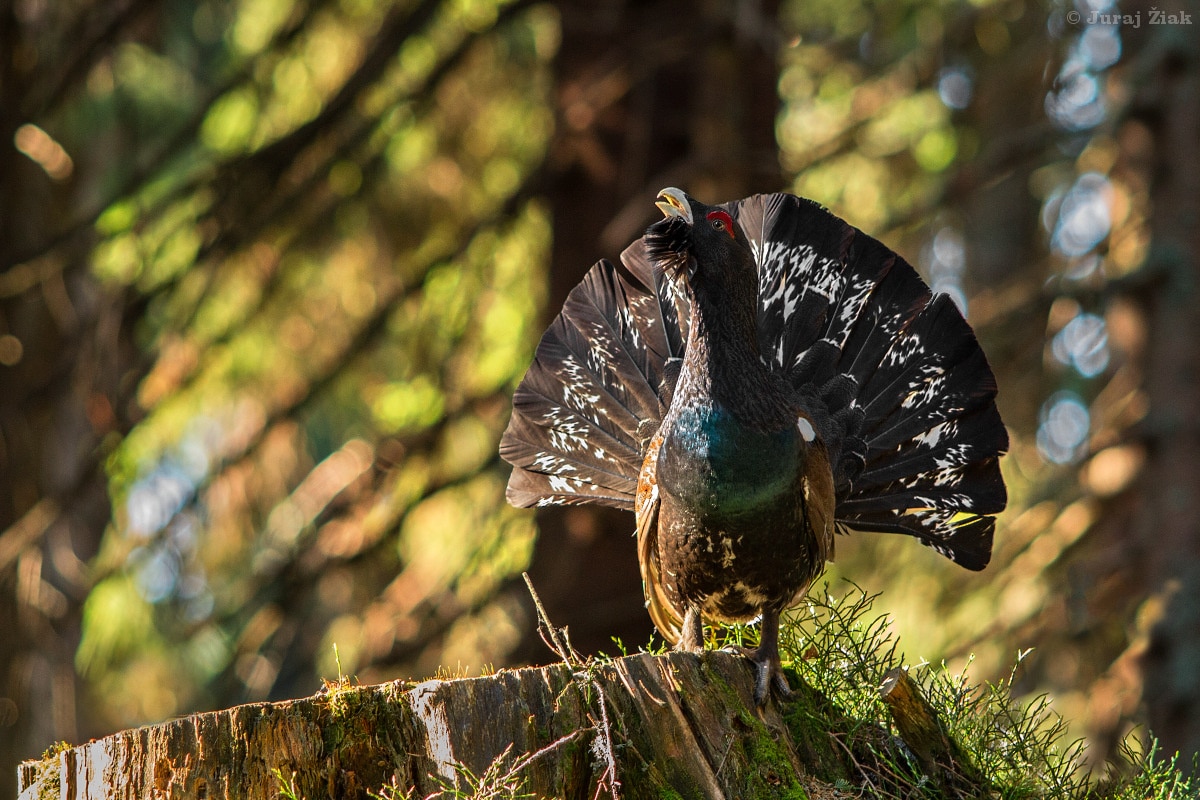
The current environmental topic of the environment, which has recently resonated in Slovakia, is the destruction of the habitat of the capercaillie (Tetrao urogallus). One of the consequences is the decline in the capercaillie population in protected bird areas. The number of individuals of this species has decreased by half since Slovakia joined the EU in 2004. The Slovak Republic has received the first warning from the European Commission in this regard and we are threatened with a hefty fine.
The fact is, however, that the fine will not be impersonated by the forest manager in any way, but we will all pay it.
The legal instruments for the protection of the capercaillie at the international level are mainly the EU Birds Directive (Directive 2009/147/EC of the European Parliament and of the Council of 30 November 2009 on the conservation of wild birds – codified version) and the EU Habitats Directive (Council Directive 92/43/EEC of 21 May 1992 on the conservation of natural habitats and of wild fauna and flora), in particular Articles 4.1 and 4.4. or Art. 6.2-6.4. At the national level, it is Act No. 543/2002 Coll. and within it the general protection of animals (Section 4 (2)) and special protection, namely protected bird areas (Section 26), the European network of protected areas “Natura 2000” (Section 28), species protection (Section 35) and compensation for the restriction of normal management (Section 61). On the application of Section 4 (2) of the cited Act, the Ministry of the Environment of the Slovak Republic issued guidelines for district offices. On the basis of a complaint, the district office is obliged to notify an entity whose activities may threaten, damage or destroy the species or its habitat and may subsequently restrict or prohibit this activity. It is a solution to exceptional situations, which, however, have been occurring more and more often in several locations over the last 10 years.
The European Commission (EC) has expressed the opinion that Slovakia has not taken sufficient steps to prevent the deterioration of the natural habitats of the capercaillie and to prevent significant disturbance of this species.
According to the EC, Slovakia has not yet taken sufficient measures in the field of capercaillie protection, which is required by the Wild Birds Directive, or in the field of planning the management of protected bird areas.

In this context, the Administration of the Veľká Fatra National Park, as well as other organizational units of the SOP SR, are initiating meetings with forest owners, users and managers in order to jointly agree on individual steps and solutions to stop the decline of capercaillie habitats. It is primarily an effort to preserve intact, top, old forest stands, which create a suitable habitat for the capercaillie, but of course also for a rich range of other organisms, as the capercaillie is a so-called “umbrella species” (the protection of the umbrella species will ensure the protection of the entire spectrum of other species tied to a similar habitat).

The first step to stop the decline of the capercaillie population must primarily be the protection of the habitat where it occurs and offers it the so-called “quiet zones” without significant human influence. In practice, however, we encounter a lack of understanding of the need for non-intervention quiet zones for the capercaillie. The main problem on the part of the owners is the “threat” of accidental calamities, whether wind or bark beetles. While we consider calamity sites to be a suitable habitat for the occurrence of the capercaillie, the forestry public perceives this fact the other way around… Practice in our country, but also in neighboring countries, clearly shows that calamities can significantly contribute to the stability and even increase of the capercaillie population. Calamity sites still meet the trophic and topical requirements of the capercaillie. Even over time, in the gradual shift of the succession stages of the forest, the calamity area gains better and better attractiveness for the species. A nice example is the current results of the capercaillie census in the Czech Republic in the Šumava National Park. According to the latest information from the census, the capercaillie population has even doubled in calamity areas.
You can find out more in a short report here: https://budejovice.rozhlas.cz/na-sumave-a-v-bavorskem-lese-pribylo-tetrevu-ukazal-pruzkum-7677343
Preserved 7th vegetation stage – spruce in the area of the Smrekovica National Nature Reserve.

The Veľká Fatra Mountains represent one of the best-preserved forest ecosystems in Slovakia, but despite this, several tokans have disappeared here in the last 10-15 years. It should be mentioned that this also applies to the tocans that were located in locations where there have been no forestry interventions in the last 20 years. However, the area of such areas is obviously small and is not sufficient to maintain a viable population of capercaillie. Individual population units are probably only slowly living out their lives, and when there is no increase for a few years in a row, of course due to the confluence of several factors, we can suddenly witness the sudden disappearance of the capercaillie even from locations where 6 roosters roared 5 years ago. A significant negative role is therefore played by the fragmentation of suitable capercaillie habitats, which cease to be freely connected. These are mostly demarcated inaccessible locations of protective forests, where forest management would be rather counterproductive. To put it simply, it can be said that the protection of the capercaillie habitat in the Veľká Fatra Mountains has been passively carried out so far.


With the loss of a sufficiently large living space, the capercaillie population in altered conditions is also significantly subject to predation, which, however, is only a secondary negative factor. Specifically, in the Veľká Fatra Mountains, it is the wild boar, which in the last 15 years has been expanding to altitudes of 1300 m above sea level and higher above the upper forest line in areas and the mountain zone. Nowadays, it is not uncommon to see carved turnings at the end of April and in May. However, predation is closely related to the insufficiently large suitable habitat of the capercaillie. In areas where calamity areas with fallen wood are left, the capercaillie is not subject to such strong pressure from wild boar. Wild boar does not like to enter calamity areas. At present, we register only two relatively viable population units in the competence area of the Administration of the Veľká Fatra National Park. In both cases, these are locations where we have not yet confirmed the regular presence of wild boar. From this point of view, it makes sense to leave calamity areas in reserves and inaccessible locations of protective forests. Here, however, the most striking contradiction arises in negotiations with managers, where the “scythe hits the stone”. While in our opinion, which has already been mentioned in this article (supported by several foreign studies from neighboring countries, e.g. Poland and the Czech Republic), the calamity area is still a suitable habitat for the capercaillie. However, forest managers cannot identify with such thinking. Forestry legislation imposes an obligation on them to cultivate such areas. If such an area is processed, the habitat with a whole range of organisms disappears, including the capercaillie, which immediately leaves such areas permanently.
Processed bark beetle calamity – such areas are permanently left by the capercaillie.

On the contrary, by leaving local calamities, loose areas are created where biodiversity can increase. The bark beetle calamity left in the Jánošíková kolkáreň National Nature Reserve still remains the habitat of the capercaillie and continues to offer it a suitable living space. It still meets both the topical and trophic requirements of the species.


Uprooted root “cakes” offer the capercaillie gastroliths and also uses them for typical “ashing”. (Gastroliths are tiny stones that accumulate in the capercaillie’s stomach and help it digest food). They are essential for the life of this species.

The capercaillie does not leave the calamity areas, but repopulates them. To some extent, this also helps him avoid predation by wild boars. Hens thus have a higher percentage of success in nesting and bringing out their young. From our point of view, the solution is a compromise and the very motivation of forest managers so that a certain percentage of the area of the area is left untouched (at least those stands that have endured in this way so far, whether they are hitherto untouched protected stands or reserves) and to connect these “caps” of natural capercaillie habitats by management that is close to nature and suitable for the survival of the capercaillie. All these management procedures are summarized in the material “PROGRAM FOR THE RESCUE OF THE CAPERCAILLIE (Tetrao urogallus Linnaeus, 1758) for the years 2018 – 2022″, which, however, is only of a recommendatory nature. You can download the full text in PDF by clicking on the highlighted document title. 


The degree of acceptance of the proposed protection of capercaillie habitats by forest owners and managers varies. In the area of competence of the Administration of the Veľká Fatra National Park , there are also entities that have been proceeding independently for several years out of their own conviction and have achieved good results and have so far kept the capercaillie in the area. We have very good experience with the company Mestské lesy Kremnica. The Svrčiník Reserve provides a quiet non-intervention zone with an area of about 220 ha and the surrounding vegetation is managed by the manager in such a way that the capercaillie uses them and the dispersion of birds is becoming more and more obvious. However, site specifics also play an important role here, which allow the manager in the surrounding stands to reduce the trunking and make random small selections – cauldrons. Therefore, we also perceive the protection of the capercaillie in cooperation with forest managers and in the common idea of preserving the capercaillie for future generations as a symbol of forests. The method of active management in management can be agreed. Experience from neighbouring Poland clearly shows that a certain area of the area where the capercaillie occurs must be in a non-intervention regime with preserved natural habitats. Otherwise, it makes no sense at all to try to manage commercial forests and forests for special purposes so that they suit the capercaillie or to consider artificial breeding of capercaillie. Such an approach to the protection of the capercaillie is important only in the second phase after the provision of non-intervention quiet zones. With the current alarming decline of capercaillie in several mountain ranges in Slovakia, there is a high probability that it will be necessary to proceed to artificial breeding of capercaillie and its restitution, similar to the surrounding countries.
Text: Ing. Juraj Žiak